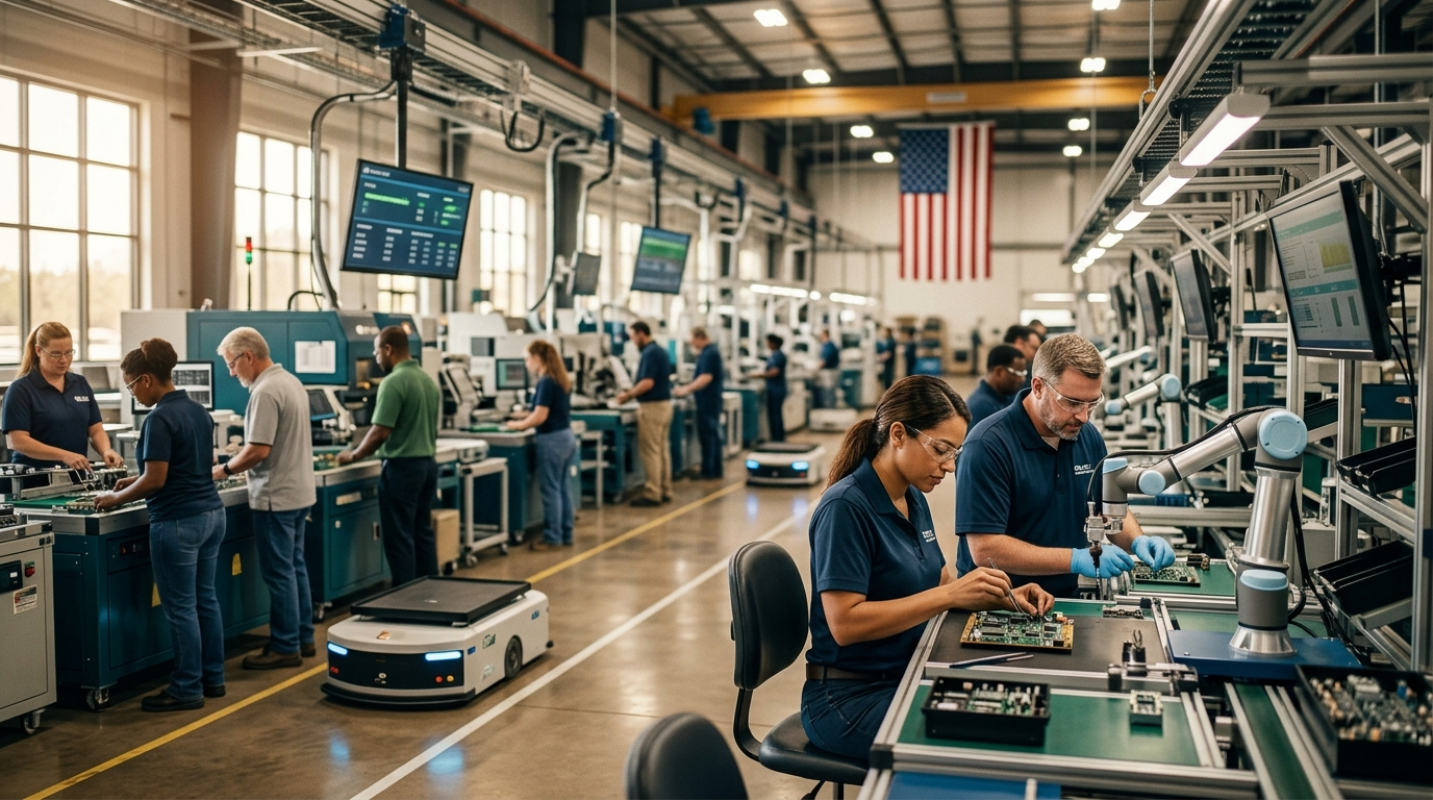
 (Image source: Gemini)
 If you’ve driven through Georgia or Tennessee lately, you’ve seen the evidence. Massive steel skeletons are rising from the red clay. Thousands of construction workers are busy building what looks like a new industrial empire. It’s not just a local trend. It’s a complete rewiring of how things get made. For decades, we were told that manufacturing was dead in America. We sent our factories to the other side of the planet to save a few pennies on labor. But the last few years changed the math. Global supply chains broke. Shipping costs went through the roof. Now, companies are rushing back. They aren't just returning to the U.S., though. They’re specifically landing in the South.
So why the South? Think of it like a perfect storm of business conditions. You have states that are aggressive about cutting red tape. You have a massive network of roads and ports. And you have a workforce that’s ready to build. Between 2018 and 2024, the region pulled in a staggering $428 billion in clean energy investments alone.¹ It’s a shift that’s making the "Sun Belt" the most important economic engine in the country.
The South is the New Manufacturing Hub
Nearshoring is the word of the decade. It’s the simple idea that making things closer to where you sell them is smarter than relying on a 10,000-mile supply chain. When you look at the numbers from last year, the South led the entire nation in reshoring and Foreign Direct Investment. In fact, the region captured 60% of all national reshoring job announcements in 2024.¹ That’s a dominant lead.
Why are these companies picking Mississippi over Michigan or South Carolina over Silicon Valley? It’s about the total cost of doing business. It’s not just about lower wages anymore. It’s about utility costs, tax incentives, and a regulatory environment that doesn't treat every new factory like a crime scene.
The economic impact is hard to overstate. We’re seeing a "Southern Exception" where regional growth is leaving the rest of the country in the rearview mirror. Georgia’s GDP is projected to grow by 2.4% this year, which is significantly higher than the national average of 1.6%.¹ When you have that kind of momentum, it creates a gravity that pulls even more investment into the orbit.
Logistics and Talent Pools
If you want to move millions of tons of freight, you need more than just a good attitude. You need infrastructure. The South has spent billions over the last decade upgrading the ports in Savannah and Charleston. These aren't just docks. They’re high-tech gateways that connect Southern factories to the rest of the world.
Then there’s the road network. The interstate corridors in the South are the veins and arteries of the American economy. A truck leaving a plant in Tennessee can reach 75% of the U.S. population within a day's drive. That’s a massive advantage when you’re trying to keep inventory lean and customers happy.
But what about the people? You can’t run a 21st-century factory with 20th-century skills. Southern universities and vocational colleges have pivoted hard to meet this demand. They’re no longer just teaching general mechanics. They’re training specialists in robotics, battery chemistry, and advanced logistics.
The cost factor is the final piece of the puzzle. Even with rising wages, operational costs in states like South Carolina remain much lower than in coastal hubs like California or New York. Interestingly, we’re seeing a shift toward high-tech output. In South Carolina, manufacturing jobs actually fell by 21% over the last few years, but the manufacturing GDP grew by 36%.⁴ It means the workers who are left are doing much more sophisticated, high-value work.
Key Industries Driving the Southern Surge
You can’t talk about Southern manufacturing without talking about the "Battery Belt." This is the stretch of land from North Carolina down to Mississippi that’s becoming the global center for electric vehicle production. Even with some market shifts recently, the investment is permanent. As of late last year, the Southeast held 38% of the nation’s $215 billion in private-sector EV and battery investments.²
Look at the scale of these projects. They aren't just factories. They’re industrial cities.
- Toyota in North Carolina: A $13.9 billion battery plant in Liberty that’s going to employ over 5,000 people.
- Hyundai in Georgia: The $12.6 billion "Metaplant" in Bryan County. It’s the largest project in the state’s history.
- Scout Motors in South Carolina: A $2 billion production center aiming for 200,000 vehicles a year.
- Ford and SK On in Tennessee: The BlueOval City complex near Memphis, which is one of the largest auto facilities ever built in the U.S.
It’s not all about EVs, though. We’re seeing a massive pivot to flexibility. Like, Hyundai is retooling its Georgia plant to produce a mix of 70% hybrids and gas vehicles because of shifting consumer demand.³ This ability to adapt is what’s going to keep these plants running for decades. Beyond cars, the South is also cleaning up in semiconductors and aerospace. It’s a diversified portfolio that makes the regional economy much more resilient.
Infrastructure and Supply Chain Resilience
It’s not all sunshine and ribbon-cutting ceremonies. When you grow this fast, things start to creak. The biggest concern right now is the power grid. These massive battery plants and semiconductor fabs eat electricity like nothing we’ve ever seen. States like Georgia and South Carolina are racing to create "energy-ready" sites, but it’s a constant battle to keep up with the demand.
Then there’s the labor issue. There’s a projected national shortage of 3.8 million workers by 2033. The South is feeling that squeeze right now. Labor-intensive operations are struggling to find enough hands, which is driving up wages and production costs. It’s a good problem for workers to have, but it’s a headache for plant managers trying to hit their margins.
Supply chains also need to be tighter. It’s not enough to have the main assembly plant in the South. You need the suppliers there, too. We’re seeing a "supplier ripple effect" where every major plant brings in dozens of smaller companies. In Georgia, Hyundai’s suppliers have already announced an extra $2.7 billion in investments.¹ This regional integration is the only way to make sure long-term stability.
If you’re a business leader or an investor looking to get a piece of this Southern surge, you need to be strategic. The easy growth phase is over. Now it’s about efficiency and technology.
- Invest in Automation: With labor shortages looming, robotics aren't optional anymore.
- Look for Energy-Ready Sites: Don't just look for land. Look for power capacity.
- Target the Hybrid Market: The shift away from pure EVs means plants that can handle multiple powertrains are the safest bet.
This article on Ratetable.co is for informational and educational purposes only. Readers are encouraged to consult qualified professionals and verify details with official sources before making decisions. This content does not constitute professional advice.